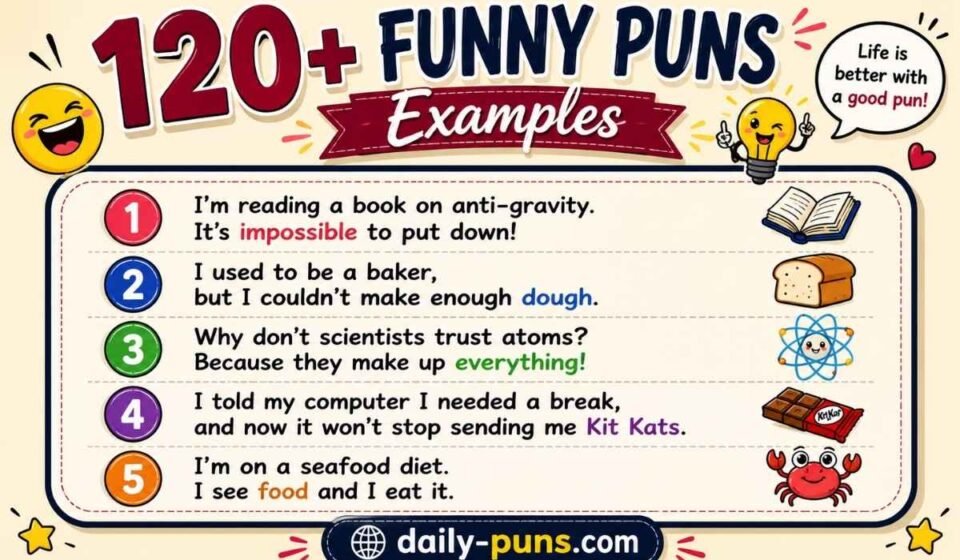

Ever laughed out loud at a joke so bad it was actually good? That’s the magic of puns. This collection of funny puns examples brings together over 120 clever one-liners, perfect for texts, captions, or just making someone groan and smile at the same time.
Puns have a way of turning an ordinary moment into a memorable one. Whether you’re looking for something to break the ice, spice up a caption, or simply make your friends roll their eyes, wordplay never really goes out of style. It’s humor that works for every age and every mood.
We’ve rounded up the best, freshest, and funniest puns for 2026 — sorted so you can find exactly what you need in seconds. Ready to dive in? Scroll down and get ready to pun your heart out.
What Is a Pun?
A pun is a form of wordplay that uses a word with two meanings, or two words that sound alike, to create a joke. The humor comes from the surprise: your brain expects one meaning, then gets hit with another.
In short, a pun works because language is flexible. The same sound or spelling can point to two completely different ideas, and a good pun makes that double meaning land in a single, quick beat.
For example, “I’m reading a book on anti-gravity. It’s impossible to put down” uses the phrase “put down” in two ways at once — physically setting the book aside, and being unable to stop reading it. That double hit is what makes a pun a pun.
More Clever Puns You’ll Love
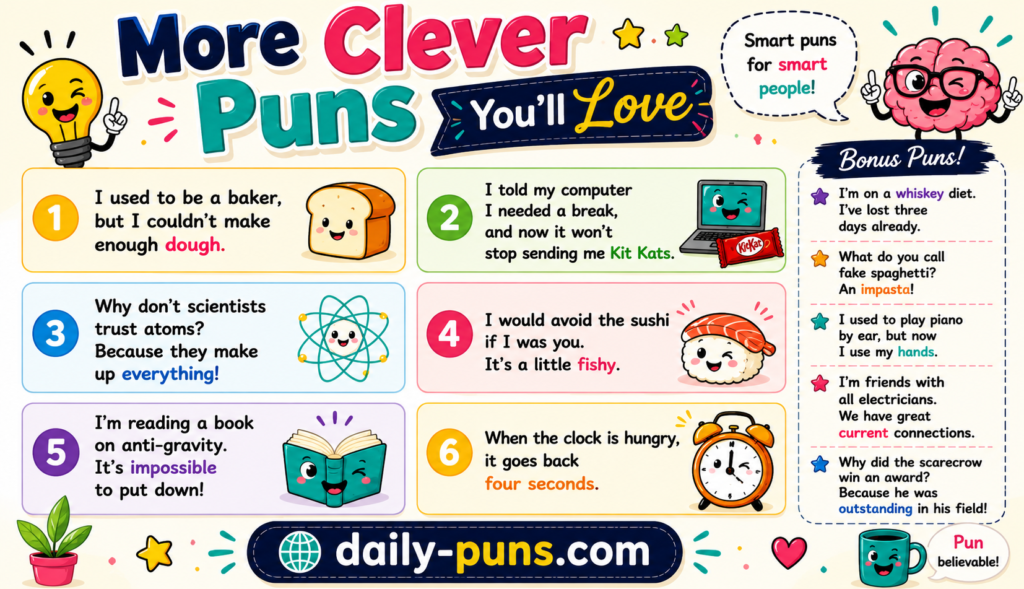
If you’re already smiling, here are a few more clever lines to keep the momentum going. These funny puns examples mix everyday situations with a sharp little twist:
- I used to be a baker, but I couldn’t make enough dough.
- Time flies like an arrow. Fruit flies like a banana.
- I stayed up all night wondering where the sun went, then it dawned on me.
- A boiled egg every morning is hard to beat.
- I’m on a roll this week — mostly because I skipped the gym for bread instead.
- Six seven-year-olds walked into a bar. Ouch, said the bar.
- The math teacher called in sick with algebra.
- I only know 25 letters of the alphabet. I don’t know y.
- A thief who stole a calendar got twelve months.
- I’d explain puns to you, but I don’t think you’d get it — yet.
Why Do Writers Use Puns?
Writers reach for puns because they do a lot of work in very few words. A single line can grab attention, add personality, and make a piece of writing feel more human all at once.
Puns also build connections fast. Readers enjoy the small “aha” moment of catching the double meaning, and that shared moment builds trust between the writer and the audience. This is one reason puns show up so often in headlines, ads, and social captions.
Beyond humor, puns show command of language. A well-placed pun signals that the writer understands rhythm, sound, and meaning well enough to bend them on purpose which is exactly why puns have survived in comedy, marketing, and literature for centuries.
Simple Pun Examples
These are short, easy funny puns examples that work for almost any audience, including kids and first-time pun fans:
- I’m friends with all electricians. We have great current connections.
- A sleeping bull is called a bulldozer.
- I used to hate facial hair, but then it grew on me.
- Bicycles can’t stand on their own because they’re two-tired.
- I burned 2,000 calories today. I left the pizza in the oven too long.
- The dentist and the manicurist had a fight over who was the better nail biter.
- I couldn’t figure out how the seatbelt worked. Then it just clicked.
- A book fell on my head. I only have my shelf to blame.
- Cats have nine lives, which makes them purr-fect at survival.
- I’d tell you a chemistry joke, but I know I wouldn’t get a reaction.
Funny Pun Examples
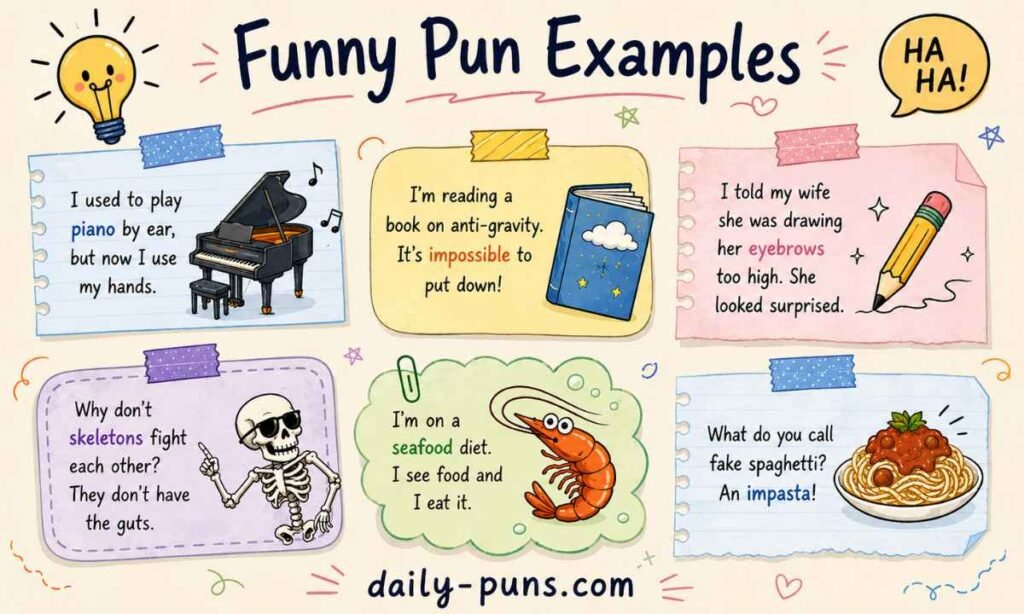
Looking for something with a little more punch? These funny pun examples land a slightly bigger laugh:
- I told my suitcase there’d be no vacation this year. Now I’m dealing with emotional baggage.
- A termite walked into a bar and asked, “Is the bar tender here?”
- I gave up my seat on the bus to a blind man. That’s how I lost my job as a bus driver.
- I used to be a personal trainer, then I gave my clients too much information — I got fired for it.
- Broken pencils are pointless.
- I wasn’t originally going to get a brain transplant, but then I changed my mind.
- The rotation of the earth really makes my day.
- I’m reading a horror story in Braille. Something bad is about to happen, I can feel it.
- I stayed at a hotel that only had one letter left on its sign. It was H-O-T-L, and the parking was included.
- Jokes about German sausages are the wurst.
Pun Examples as a Figure of Speech
A pun is technically classified as a figure of speech, right alongside metaphors and similes, because it changes the literal meaning of language to create a stronger effect. Instead of comparing two things like a metaphor does, a pun overlaps two meanings inside the same word or phrase.
Here’s how that plays out in real lines:
- “Seven days without pun makes one weak.” (weak/week)
- “I’m not a fan of stairs. They’re always up to something.” (up to something = suspicious behavior + literally going upward)
- “A horse is a very stable animal.” (stable = calm + a place horses live)
- “The past, the present, and the future walked into a bar. It was tense.” (tense = grammar tenses + awkward mood)
This is what separates a pun from a simple joke: the humor lives directly inside the wording, not just the situation.
Types of Puns
Not all puns work the same way. Understanding the different types makes it easier to spot them — and to write your own. Here are the main categories:
| Type | How It Works | Example |
| Homophonic pun | Uses words that sound alike but have different meanings | “Two silk worms had a race. It ended in a tie.” |
| Homographic pun | Uses one word spelled the same but with two meanings | “The bicycle couldn’t stand up because it was two-tired.” |
| Compound pun | Combines two or more puns in a single sentence | “Old cheesemakers never die, they just go on holidays and lactose interest.” |
| Recursive pun | Requires understanding an earlier part of the joke to get the second part | “Time flies like an arrow. Fruit flies like a banana.” |
| Visual pun | Relies on an image or spelling trick instead of sound | A sign reading “Lawn & Order” outside a landscaping business |
Knowing these categories helps you appreciate why some puns feel clever and layered, while others are simple and quick.
Pun Examples in Literature
Puns aren’t just for captions and casual jokes — they’ve been part of serious writing for centuries. William Shakespeare is one of the most famous pun-users in the English language, weaving wordplay into tragedy, comedy, and everything between.
A well-known example comes from Romeo and Juliet, where the dying Mercutio says he will be found “a grave man” tomorrow — playing on “grave” as both serious and a burial site. It’s a dark pun that lands right at a turning point in the play.
Lewis Carroll also leaned heavily on puns in Alice in Wonderland, including the famous exchange about lessons: “lessons” grow shorter each day because they “lessen.” Even modern authors use puns to add rhythm and personality to dialogue, proving that this playful device has real literary weight — not just internet-caption value.
Pun Examples for Adults
These funny puns examples lean a bit more toward workplace humor, relationships, and everyday adult life:
- My therapist says I have a preoccupation with revenge. We’ll see about that.
- I told my wife she should embrace her mistakes. She gave me a hug.
- Marriage is a workshop where the husband works and the wife shops.
- I have a fear of speed bumps, but I’m slowly getting over it.
- My boss told me to have a good day, so I went home.
- I’m on a seafood diet. I see food, and I make better choices than I used to.
- Relationships are like algebra. You look at your X and wonder Y.
- I used to be indecisive. Now I’m not so sure.
- My landlord asked why I hadn’t paid rent. I said the ball was in his court, since he never fixed the fence.
- Adulting is just googling how to do things and hoping for the best.
How to Create Your Own Puns
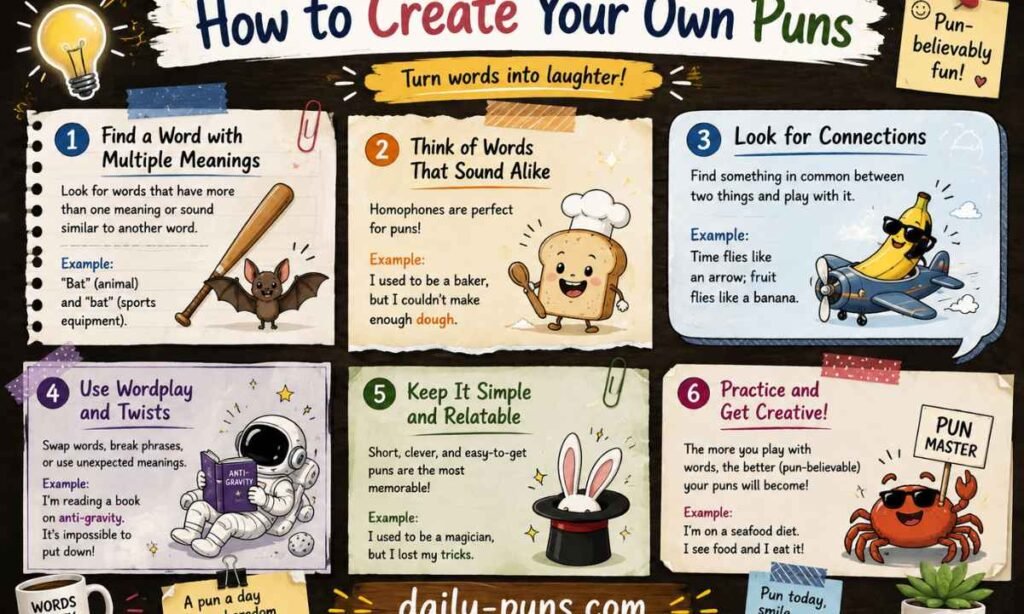
Writing your own puns is easier than it looks once you know the pattern. Start with these steps:
- Pick a word with a double meaning. Words like “current,” “stable,” “grave,” or “matter” all carry more than one definition.
- List both meanings side by side. Write down the literal meaning and the secondary or sound-alike meaning.
- Build a sentence that fits both meanings at once. The best puns work naturally in either interpretation, not just one.
- Say it out loud. If the double meaning is instant, it’s a strong pun. If you have to explain it, simplify further.
- Trim the sentence. Shorter puns almost always land better than long ones.
A quick example of this process: the word “flour/flower” sounds identical. That leads to a line like, “The baker stopped to smell the flour” — simple, clean, and instantly clear.
Common Mistakes When Writing Puns
Even good puns can fall flat if a few small things go wrong. Watch out for these common mistakes:
- Overexplaining the joke. If you have to add “get it?” the pun already lost its punch.
- Forcing a connection that isn’t there. Not every word has a natural double meaning — don’t stretch it too far.
- Stacking too many puns in one line. One clean pun beats three confusing ones.
- Ignoring the audience. A workplace pun and a kids’ pun need different tones and different words.
- Using an obscure reference. If most readers won’t know the second meaning, the joke won’t land.
Avoiding these mistakes is often the real difference between a pun that gets a groan-laugh and one that just gets a blank stare.
FAQs
What is the funniest type of pun?
This depends on personal taste, but compound puns — where two or more wordplays combine in one line — tend to get the biggest reactions because they reward close listening.
Are puns considered good writing?
Yes. Puns are a recognized figure of speech and have been used by respected writers, including Shakespeare, for centuries. Used well, they add rhythm, personality, and memorability to writing.
How do I use puns without sounding forced?
Keep the sentence short, make sure both meanings are common knowledge, and only use a pun where it fits the topic naturally — not just to squeeze in a joke.
Can puns be used in professional writing?
Light, clean puns work well in marketing copy, headlines, and social captions. They’re best avoided in formal reports or documents where clarity matters more than humor.
Conclusion
Puns aren’t just quick jokes, they’re proof that a few clever words can turn an ordinary sentence into something worth sharing. Whether you picked a favorite from the simple list, the literary examples, or the ones made for grown-up humor, you now have over 120 funny puns examples ready to use anytime.
The best part about puns is how versatile they are. They work in a text to a friend, a caption under your morning coffee photo, or even a line in a speech that needs a little warmth. A good pun doesn’t need a big audience to land it just needs the right moment.
Puns are the ultimate proof that a bad joke can still be a good time. They twist words, flip meanings, and turn everyday language into a punchline you didn’t see coming. Whether you love them or groan at them, one thing is true — a good pun always gets a reaction.
In this collection, you’ll find over 120 funny puns covering everything from food and animals to love and work. Each one is short, easy to remember, and perfect for texts, captions, or just making someone laugh out loud. Let’s dive into the ultimate list of clever wordplay for 2026.